Kharg Island: The Tiny Island That Could Crash the World Economy
There is a small island in the Persian Gulf that most people have never heard of. It is roughly a third the size of Manhattan. It has no famous beaches, no tourist hotels, and fewer than 20,000 permanent residents. But right now, it is the most important piece of real estate on the planet.
That island is Kharg Island. And if you want to understand why oil prices are above $100 a barrel, why your energy bills are rising, and why the Trump administration is weighing a military occupation of an island 7,000 miles from Washington, D.C., you need to understand Kharg.
For the full strategic breakdown, read the deep-dive feature at Apple Daily UK: Kharg Island — Iran’s Crown Jewel and the World’s Most Dangerous Chokepoint.
What Is Kharg Island and Why Does It Matter?
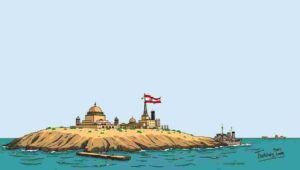 Kharg Island sits about 25 kilometres off Iran’s southwestern coast in the Persian Gulf. It is small, flat, and surrounded by deep water — and that last point is everything. Most of Iran’s coastline is too shallow for supertankers. Kharg is not. Its deep natural harbour, combined with decades of infrastructure investment, has made it the exit point for roughly 90 to 94 percent of all Iranian crude oil exports.
Iran exports around 1.5 to 1.6 million barrels of oil per day in normal times. Almost all of it leaves through Kharg. That oil generates roughly $53 billion a year for the Iranian government — more than a quarter of its total public budget. Without Kharg, Iran cannot pay its army, fund its nuclear programme, support its proxies in Yemen, Lebanon, or Iraq, or keep the lights on at home.
That is not an exaggeration. The International Monetary Fund estimates Iran needs oil prices above $163 per barrel just to balance its national budget — the highest fiscal pressure point of any major oil producer in the world. Kharg is not just important to Iran. It is Iran’s financial life support.
A History of Bombs, Empires, and Oil
Kharg has been fought over for a very long time. The Portuguese seized it in 1507. The Dutch bought “perpetual ownership” in 1753 for 2,000 rupees — and were kicked out thirteen years later. Britain occupied it twice in the 1800s. Oil infrastructure arrived in the 1950s when American company Amoco built the first terminal, connected by pipeline to Iran’s inland oilfields.
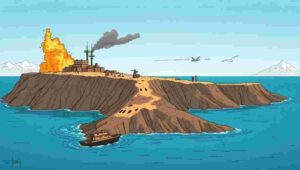
The island’s modern strategic importance was proven — and nearly destroyed — during the Iran-Iraq War of the 1980s. Iraq bombed Kharg relentlessly for eight years. In 1984 and 1985 alone, Iraqi aircraft struck it more than 44 times in a single three-month stretch, cutting Iran’s export capacity almost in half. Iran responded by running tankers in a costly relay operation further down the Gulf, out of Iraqi range. The oil kept flowing. Kharg was battered but never broken.
That resilience is part of why it remains so central today — and part of why attacking it is so complicated.
Operation Epic Fury: What Just Happened
On February 28, 2026, the United States launched Operation Epic Fury — the largest American military operation in the Middle East since the 2003 Iraq War. B-2 stealth bombers, B-1B Lancers, Navy strike aircraft, and Tomahawk cruise missiles hit thousands of targets across Iran. Iran retaliated with ballistic missiles and drones and moved to close the Strait of Hormuz — the narrow waterway through which roughly 20 million barrels of oil transit every single day.
Then came the pivotal moment. On March 13, 2026, U.S. aircraft struck Kharg Island for nearly two hours. They hit air defence systems, missile bunkers, the naval base, the airport runway, and helicopter facilities. They destroyed Iran’s military presence on the island almost completely.
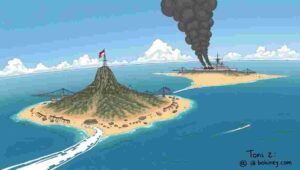
But they left every oil tank, every pipeline, and every loading terminal completely untouched.
Trump explained it himself on Truth Social: “We hit Kharg Island, took out every single thing except one thing — we left the pipes. If we take out the pipes, that’s a long time to build.”
This was not restraint. It was leverage. The oil infrastructure remains standing as a bargaining chip — a threat Trump can cash in if Iran does not reopen the Strait.
The $150 Question Nobody Wants to Answer
Markets understand exactly what is at stake. The International Energy Agency called this crisis the largest oil supply disruption in the history of the global oil market. The IEA released 400 million barrels from member nations’ strategic reserves — the biggest emergency release ever. Oil stayed above $100 a barrel anyway.
Financial analysts at firms including Kpler have warned that a full strike on Kharg’s oil infrastructure — not just its military installations — could push Brent crude to $150 per barrel or beyond. Iran’s only backup terminal, at Jask on the Gulf of Oman, can handle roughly 300,000 barrels per day. Kharg handles more than five times that amount. There is no realistic alternative.
For China, the stakes are especially severe. China buys roughly 90 percent of Iran’s oil exports — around 1.4 million barrels per day — mostly at a steep discount, routed through a shadow fleet of tankers that disguise their origin. Chinese strategic reserves stood at about 1.39 billion barrels heading into the conflict, covering roughly 120 days of imports. That buffer is substantial but finite. Beijing has protested the strikes diplomatically while quietly stockpiling. War on the Rocks analysis suggests China could absorb a three-to-four month disruption before facing real economic pain.
Russia, meanwhile, is laughing all the way to the bank. Every dollar added to the global oil price fills the Kremlin’s war chest. Russia’s fossil fuel revenues surged to an estimated €7.7 billion in the first two weeks of the war alone.
The Trap: Why Taking Kharg Is Easier Said Than Done
The Trump administration is now openly considering seizing or blockading Kharg Island to force Iran to reopen the Strait. On March 20, Axios reported a senior administration official saying: “He wants Hormuz open. If he has to take Kharg Island to make it happen, that’s going to happen.”
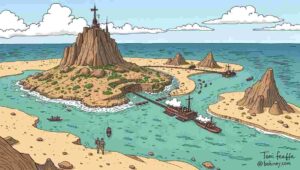
The problem is that Kharg sits just 25 kilometres from the Iranian mainland. Any occupation force would be surrounded. Iranian missiles, artillery, drones, and coastal batteries could rain down on the island continuously. The waters around it could be mined within hours. Security analysts at the Quincy Institute described a forced seizure as landing “somewhere between a suicide mission and a self-imposed hostage crisis.”
There is also a deeper strategic trap. Iran is unlikely to close the Strait of Hormuz unless its oil exports are already gone — because an open Strait is worth more to Iran than a closed one. If the U.S. destroys Kharg’s oil infrastructure, Iran loses its main reason to keep the Strait open. The leverage disappears along with the pipelines.
As of March 23, 2026, Trump postponed planned strikes on Iranian power plants for five days, claiming diplomacy was underway. Iran denied any talks were happening. Oil dropped nearly 11 percent on the news, settling just below $100. Nothing was resolved.
The Bottom Line
One island, roughly 20 square kilometres, is holding the global economy hostage. It has done this before — during the 1980s, under sustained Iraqi bombardment, Iran kept pumping. The infrastructure survived. The question today is whether American military dominance, Iranian defiance, and Chinese economic exposure can all co-exist in a standoff that nobody — not Trump, not Tehran, not Beijing — has a clean exit from.
The pipes are still standing. That is the only fact that matters right now.
For the full 2,000-word deep-dive on Kharg Island’s complete history, military analysis, economic data, and geopolitical implications, read the original feature at Apple Daily UK.